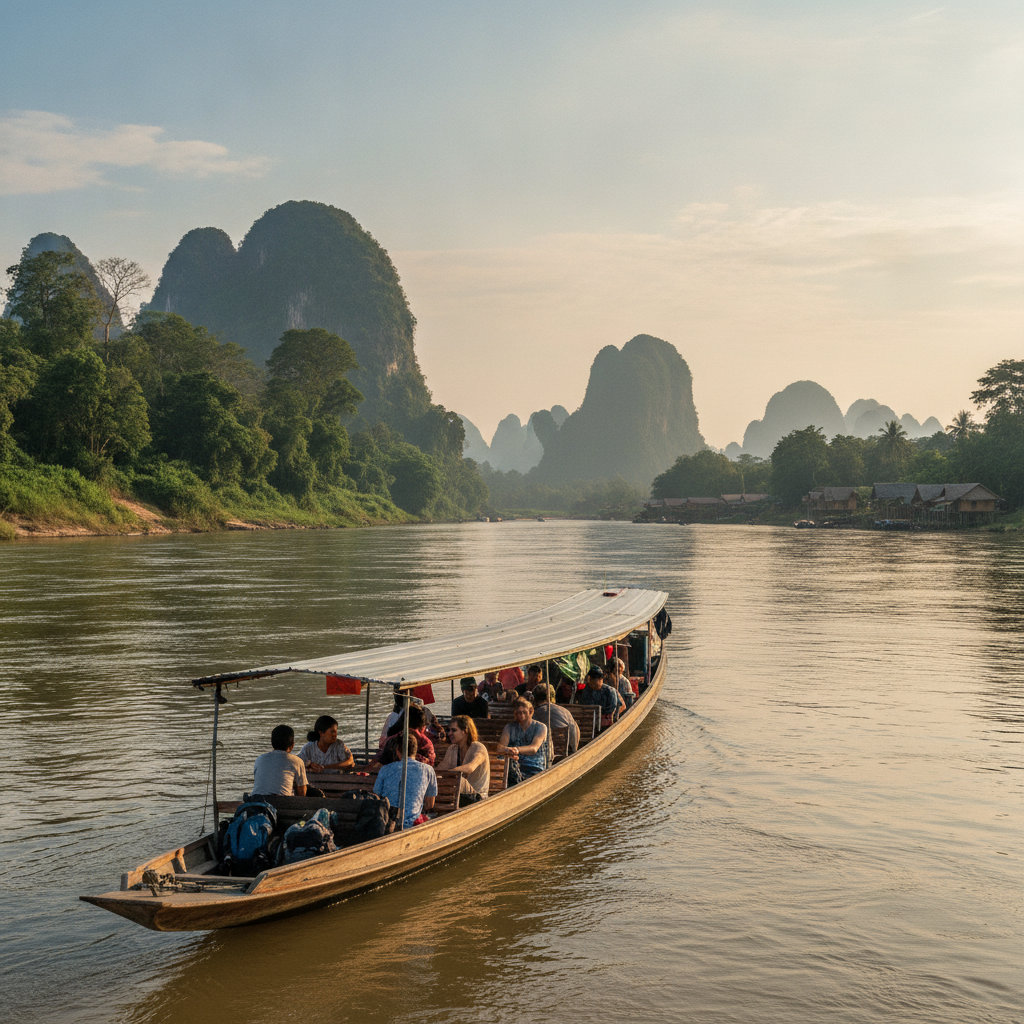
Slow travel has a way of rewarding the patient. Nowhere is that more true than along the Mekong River in Laos, where wooden passenger boats drift between forested hills and stilted villages at a pace that lets the country actually sink in. For travelers who want to move through Laos without hopping on a domestic flight, the slow boat network offers something rare — a journey that feels like the destination itself, not just the transit between them.
Book Your Slow Boat Departure From Huay Xai
The classic slow boat route begins at Huay Xai, a small border town on the Lao side of the Mekong, directly across from Chiang Khong in Thailand. Most travelers arrive here after crossing from northern Thailand, making it a natural starting point. Boats typically depart in the morning and follow a two-day schedule down to Luang Prabang, with an overnight stop in Pakbeng. Tickets can be purchased at the pier itself or through guesthouses in town, and it's worth booking a day in advance during peak season — space on the wooden bench seats fills up faster than you'd expect.
Understand What the Two-Day Journey Actually Involves
The Luang Prabang slow boat covers roughly 300 kilometers over two full days on the water. Each day runs approximately six to eight hours, depending on river conditions and how many villages the boat stops at along the way. The vessels are long, low-slung wooden boats with bench seating, open windows, and a small snack vendor onboard. Passengers share the space with a mix of backpackers, local travelers, and the occasional monk. It's not luxurious, but it's genuinely comfortable — bring a small cushion if you have one, and pack enough snacks to supplement what's available onboard.
Choose the Right Boat for Your Comfort Level
Not all Mekong slow boats are the same. The standard government-run ferries carry the most passengers and are the most affordable option. Several private operators, including Luang Say Cruises, run higher-end vessels with better seating, meals, and included accommodation at riverside lodges. The premium boats cost significantly more but attract travelers who want a more structured, comfortable experience. Standard boats attract a younger, more social crowd. Think about what kind of journey you're after before buying a ticket — the river view is the same regardless, but the social atmosphere onboard can vary considerably.
Plan Your Overnight Stop in Pakbeng Carefully
Pakbeng is the midpoint village where all slow boats stop for the night. It's a small hillside town that exists almost entirely to service Mekong travelers, and it does the job reasonably well. Guesthouses line the main street near the pier, ranging from very basic to clean and comfortable. Arriving boats tend to dock in the early to mid-afternoon, which gives travelers time to explore, eat a proper meal, and rest before the second day. Don't overthink the accommodation — most places are affordable and functional. What matters more is getting to the pier early the next morning, as boats leave promptly and won't wait.
Extend the Journey Beyond Luang Prabang on Local Ferries
Luang Prabang is where the main tourist slow boat route ends, but the Mekong doesn't stop there. Local passenger ferries continue south toward Vang Vieng and eventually toward Vientiane, though these routes are less structured and require more flexibility. Schedules change with the season and water levels, so this section of the journey rewards travelers who aren't locked into fixed dates. The ferry office near the Luang Prabang waterfront is the best place to ask about current routes and departure times. Traveling this section puts you firmly in local transport territory — far fewer tourists, far more authentic interactions.
Pack Strategically for Life on the Water
A slow boat is not the place to be wrestling with an oversized backpack. Large luggage gets stored at the back of the boat, so anything you need during the day — snacks, a book, a light jacket for wind chill on the water — should go in a small daypack. The Mekong can be surprisingly cool once the boat is moving, even when the air temperature onshore feels warm. A sarong or light blanket doubles as warmth and a cushion. Bring more water than you think you'll need, a fully charged power bank, and a set of earplugs if you plan to sleep on the second morning's journey.
Time Your Trip Around River Conditions and Season
The Mekong's water levels shift dramatically across the year, and that affects both travel speed and scenery. The dry season, roughly November through April, brings lower water and clearer views of the riverbanks, with sandbanks and rocky outcrops visible from the boat. The wet season raises the water level significantly, which speeds up the journey but changes the character of the banks. The peak travel months of December and January see the most competition for tickets. Traveling in shoulder season — October or late April — tends to offer a good balance of reasonable weather, manageable crowds, and excellent scenery along the riverbanks.
Use Luang Prabang as a Base for Onward Overland Travel
Arriving in Luang Prabang by slow boat sets up a natural transition to the rest of Laos by road or river. Minivan services connect to Vang Vieng in around four hours, and from Vang Vieng, the journey to Vientiane is another three to four hours by bus or shared van. The entire overland route from the Thai border to the Lao capital can be completed without a single flight, using the Mekong as the northern leg and road transport through the central highlands. It takes longer than flying, but the country reveals itself in a way that a 45-minute domestic flight simply can't replicate.
The slow boat culture along the Mekong has remained remarkably consistent for decades, but infrastructure in Laos continues to evolve. A high-speed rail line now connects Vientiane to the Chinese border via Luang Prabang, which means travelers in 2026 have more transport options than ever before. The appeal of the river journey hasn't diminished — if anything, the contrast between modern rail and ancient waterway makes the slow boat feel even more worth choosing. For anyone willing to trade speed for experience, the Mekong remains one of the most rewarding ways to move through a country that genuinely rewards patience.