There is a particular kind of travel that no itinerary can fully prepare a visitor for — the kind that begins the moment a city stops performing for tourists and starts living entirely for itself. Across Southeast Asia, public holidays create exactly this condition. Markets overflow not with curated handicrafts but with families doing their actual shopping. Temples fill with worshippers who aren't there for the photographs. Streets that guidebooks describe as "bustling" become something else entirely: genuinely, almost overwhelmingly alive with ritual, noise, and communal meaning that has nothing to do with the traveler standing in the middle of it.
When the Calendar Transforms Ordinary Places
The regional calendar in Southeast Asia is dense with observances — Songkran in Thailand, Tết in Vietnam, Hari Raya Aidilfitri across Malaysia and Indonesia, Loy Krathong along the northern river towns — and each one reshapes its host city in ways that printed travel guides consistently underestimate. The physical geography of a place doesn't change during a public holiday, but the emotional geography shifts completely. A street in Chiang Mai's Old City that reads as a pleasant walking route on a Tuesday in March becomes, during Songkran in April, a full-scale water festival corridor where the rules of normal movement dissolve. The experience isn't simply more festive; it's categorically different, governed by social logics that visitors can observe but rarely fully decode without some preparation.
What makes these moments so distinct is the suspension of the usual transactional relationship between tourist infrastructure and the traveler. During major holidays, local residents reclaim public space in ways that sideline the tourism economy almost entirely. Restaurants may close without notice, or pivot entirely to feeding extended family networks. Guesthouses in smaller towns sometimes operate on skeleton staff while owners travel to their home provinces. The traveler who arrives expecting standard service rhythms will be disoriented. The one who arrives knowing what week it is — and why — will find themselves watching something rare: a society being fully, unselfconsciously itself.
Reading the Rhythm Before Arriving
Understanding the cadence of local holidays requires more than a quick search. The lunar calendar governs many observances across the region, meaning dates shift annually, sometimes significantly. Vesak Day — known as Visakha Bucha in Thailand — honors the birth, enlightenment, and passing of the Buddha, and falls on the full moon of the fourth lunar month, placing it anywhere from May to June depending on the year. During this observance, the atmosphere around temple complexes like Wat Pho in Bangkok or Shwedagon Pagoda in Yangon changes at the level of light and sound: candles, chanting, and the particular stillness of mass devotion replace the usual ambient tourism noise. A visitor who happens to arrive during Vesak without knowing it is almost certainly going to misread what they're seeing — interpreting deep collective reverence as a performance rather than recognizing it as something private made temporarily visible.
The practical dimension matters too. During Tết in Vietnam, Hanoi and Ho Chi Minh City experience a partial evacuation as millions of urban residents return to ancestral homes in rural provinces. This *về quê* (literally, "return to the homeland") tradition empties certain neighborhoods while filling others, and reshapes the availability of transport, food stalls, and services across the country for several days on either side of the lunar new year. Travelers who plan standard sightseeing itineraries for this window often find themselves wandering streets that feel strangely quiet — not because Vietnam is having a slow week, but because the country is simply elsewhere, doing something more important.
The Etiquette That Goes Unwritten
Guidebooks tend to cover the broad strokes of holiday etiquette — dress modestly near temples, don't point with your feet, observe silence during prayer — but the subtler codes of conduct during festivals are rarely documented in useful detail. During Hari Raya Aidilfitri, the celebration marking the end of Ramadan, the practice of *open house* — *rumah terbuka* in Malay — means that families across Malaysia and Singapore genuinely welcome visitors, including strangers, to share food and greetings. This isn't a tourist attraction; it's a sincere social custom. A traveler who understands this context and accepts an invitation gracefully participates in something that no museum exhibit or cultural tour can replicate. One who declines out of uncertainty about whether the invitation is real misses a moment of genuine human exchange.
The unwritten etiquette also extends to what travelers shouldn't do. Photographing religious processions without judgment about timing and proximity is one of the more common ways well-meaning visitors inadvertently create friction during holidays. A merit-making procession — *tak bat* in Laos, where monks collect alms at dawn along routes in Luang Prabang — is a sacred act of daily life that has, in certain tourist-heavy seasons, been turned into a spectacle. During official holidays, when local participation increases dramatically, the imbalance between observer and observed can become particularly pronounced. Reading the scene carefully, stepping back, and following the lead of local bystanders rather than other tourists is often the most honest form of cultural respect available to a traveler.
What the Experience Actually Teaches
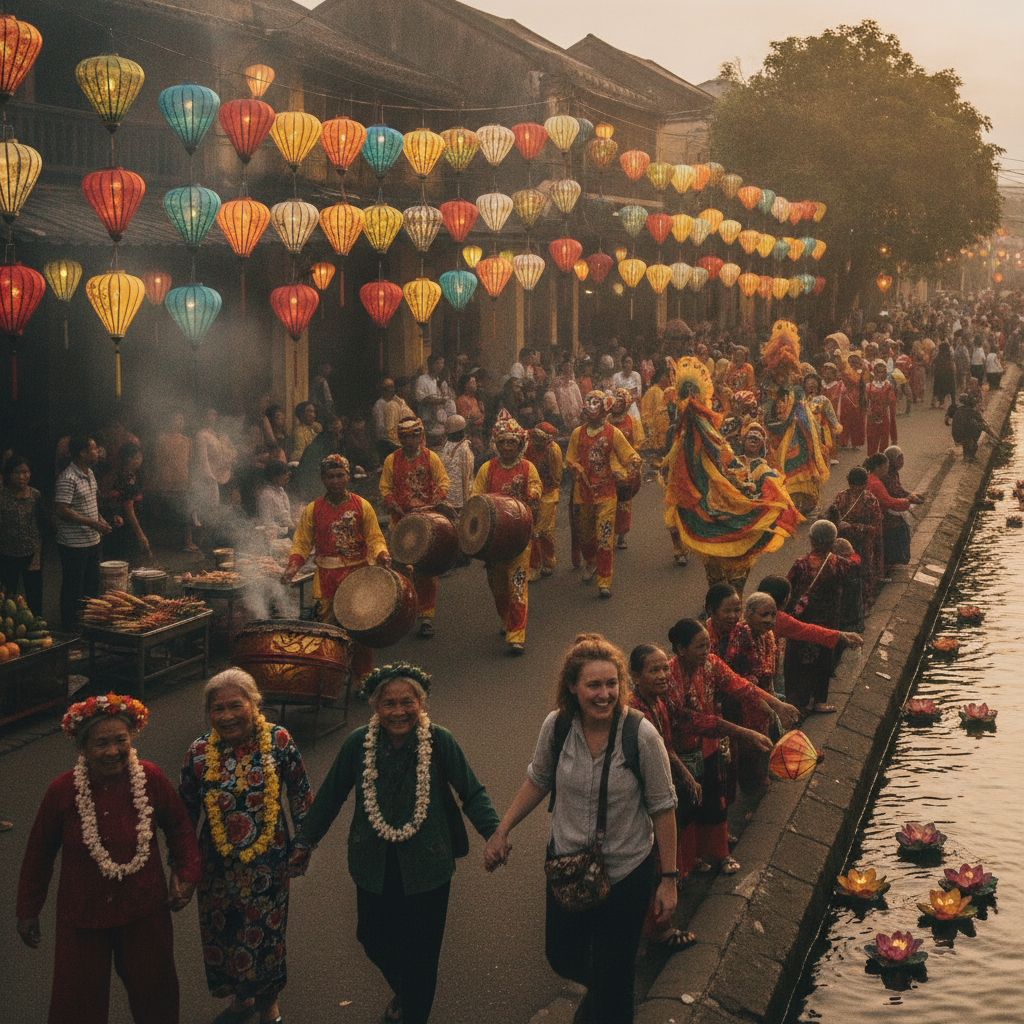
If you find yourself in Southeast Asia during a major public holiday — by intention or by the pleasant accident of flexible travel planning — the most useful shift is to release the itinerary's authority over your day. The cultural experience that emerges from a local holiday isn't organized for your consumption, and that's precisely what makes it worth paying attention to. Follow the crowds toward the river during Loy Krathong and watch as thousands of small lotus-shaped floats carrying candles and incense are released onto the water — each one a *krathong* representing a prayer, an apology, or a wish set loose from the hands that made it. Stand at the edge of that scene and understand that you are not the point of it, and that being not the point of something beautiful is its own particular kind of gift.
Traveling during local public holidays in Southeast Asia returns the traveler to a more honest position — that of witness rather than consumer. The scene that opened this piece, of a city living entirely for itself, is not an inconvenience to be managed around but an invitation to a different kind of attention. The guidebook gets left behind not because it was wrong, but because the moment exceeds what any structured advice can hold.