There is a particular kind of exhaustion that comes from moving through Europe too quickly — the blur of station platforms, the overnight bag never fully unpacked, the sensation of having seen a great deal while absorbing very little. Bus and rail tours are efficient by design, threading through cities with the logic of a timetable rather than the curiosity of a traveler. River cruising through Central Europe operates according to an entirely different philosophy, one that trades speed for presence and arrives at something closer to understanding.
The major rivers of Central Europe — the Danube, the Rhine, and the Main — have served as corridors of commerce, culture, and conflict for centuries. Following them by boat means following the actual grain of the continent's history rather than cutting across it. The river itself becomes a kind of organizing principle, not just a backdrop. A traveler waking on a riverboat moored in Regensburg experiences the medieval Altstadt, or old town, from a fundamentally different angle than one who steps off a train with two hours before the next departure.
The Architecture of Stillness
What distinguishes a river cruise itinerary is not the absence of movement but the quality of it. The boat moves, cities shift, landscapes change — but the home base remains constant. Cabins stay the same, meals happen in the same dining room, and the rhythm of the day is set by the vessel rather than by a printed schedule of connection times. This continuity creates a kind of psychological stillness that is difficult to manufacture in other formats. A traveler on a bus tour wakes each morning in a different hotel room, reorienting, repacking, reassessing. On a riverboat, the only thing that changes overnight is the view through the window.
That constancy has practical consequences for how deeply a destination registers. When there is no pressure to sprint to the next embarkation point, towns like Dürnstein in the Wachau Valley — a small Austrian settlement famous for its ruined hilltop castle and apricot orchards — can be experienced rather than simply checked. The Wachau Valley itself is a UNESCO World Heritage Site, and the river provides the ideal frame for its terraced vineyards and baroque church spires. Slowing down, it turns out, is not a passive choice; it is an active method for seeing more clearly.
How the Itinerary Structure Actually Changes Behavior
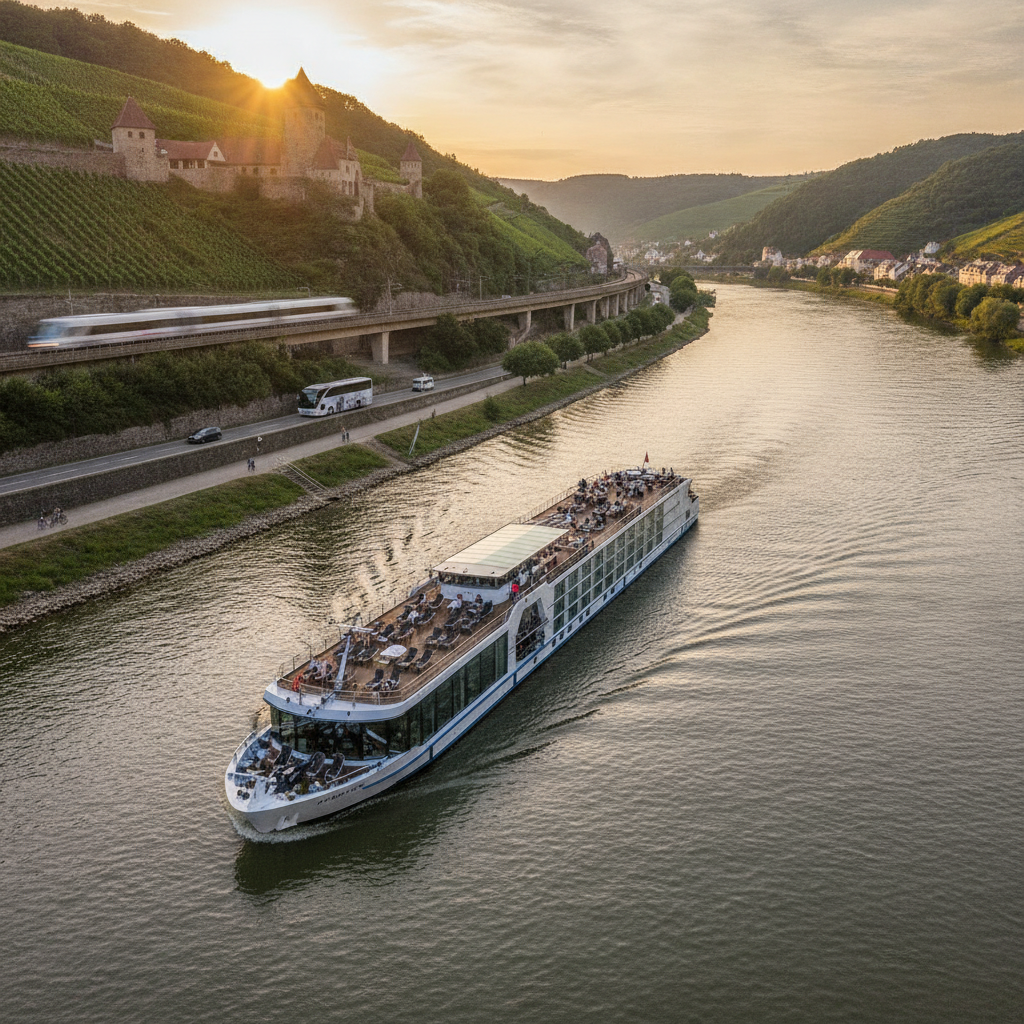
Bus and rail tours are structured around transit — the journey between points is largely dead time, a gap to be managed with a podcast or a nap. River cruising collapses that distinction. The journey between Passau and Linz, for instance, is not dead time; it is an uninterrupted corridor of Lower Bavarian countryside, river bends, and castle ruins that demands attention. Passengers who expected to sleep through it often find themselves leaning against the observation deck railing instead.
This quality of the in-between is something that neither rail nor bus touring can fully replicate, because trains move too quickly and buses too close to the ground. The river's pace — roughly walking speed in many stretches — is calibrated to human perception. It is fast enough to cover significant ground over a week-long itinerary, which might carry a traveler from Amsterdam through Cologne and Frankfurt to Budapest or Vienna, but slow enough that the eye has time to compose and hold what it sees. The German term *Gemütlichkeit* — loosely translated as a warm, unhurried conviviality — is often associated with Bavarian culture, and it is the closest linguistic shorthand for the emotional register that river travel seems to produce in its passengers.
What Shore Time Looks Like Without a Return Deadline
One of the sharper differences between river cruising and land-based touring reveals itself during port stops. When a riverboat docks in Bratislava or Melk, passengers typically have between three and six hours ashore. That window is long enough to wander without agenda, to sit in a café on Obchodná Street, to find a local market that wasn't in any brochure, to have a conversation that goes somewhere unexpected. Rail travelers, by contrast, often operate under a tighter calculus — catching the next train means accounting for station distances, luggage, and platform changes that consume the loose edges of every stop.
The difference accumulates. Across a seven-day river itinerary, those unhurried hours compound into something resembling genuine familiarity with a place. Travelers consistently report that Central European river routes produce a different quality of memory than equivalent land-based journeys — less a list of attractions visited and more a felt sense of the region's character, its palette, its particular combination of Habsburg formality and riverside ease. That quality of memory is not incidental; it is the point.
The Kind of Travel This Pace Is Actually Built For
River cruising is not the right format for travelers who measure a trip by the number of cities crossed or the volume of monuments photographed. It asks for a willingness to let a place come to you as much as you go to it — to spend a morning watching the Danube work its way through the Wachau rather than racing through a museum collection. For those open to that exchange, the rewards are specific and durable. You return not with a folder of itinerary confirmations but with the particular light of a Viennese afternoon still somewhere behind your eyes, the memory of a meal that had no name in any language you speak, the unshakeable sense that you were, for a week, actually somewhere.
If that version of travel sounds appealing, Central Europe's river network is one of the most rewarding places on earth to pursue it. The infrastructure is mature, the landscapes are extraordinary, and the pace — that steady, unhurried pace — does the deepest work quietly, over days, the way rivers always have.