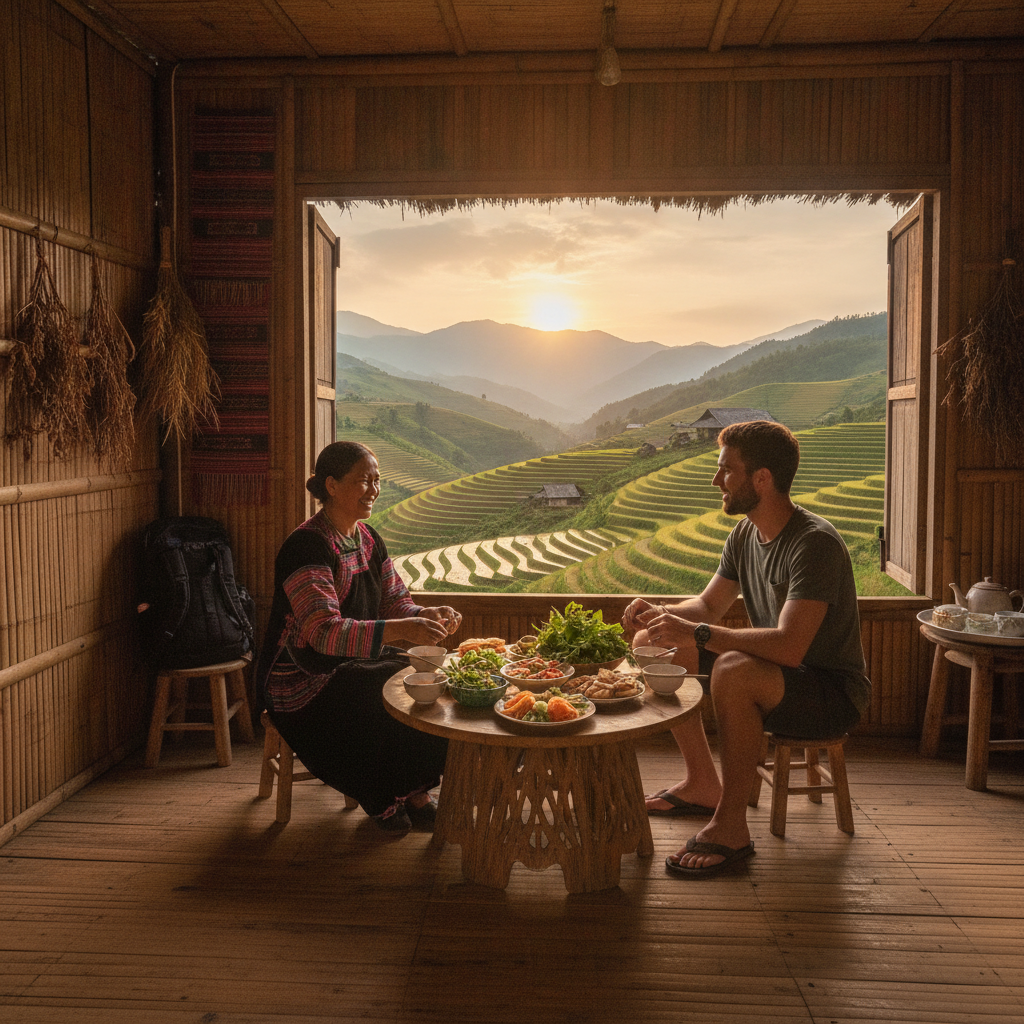
Travel has a way of flattening itself when comfort becomes the primary currency. A traveler arrives in Vietnam, checks into a polished resort somewhere along the Đà Nẵng coastline or outside Hội An's lantern-lit streets, and spends a week insulated by pool decks, buffet breakfasts, and lobby art that could belong to any hotel on any continent. The country is right there — its sounds, its rhythms, its particular quality of morning light — and yet the experience remains oddly distant, like watching a documentary through a screen rather than stepping into the frame.
What a Guesthouse Actually Offers Beyond a Room
Locally owned guesthouses, called *nhà nghỉ* in Vietnamese (literally "resting house"), operate on an entirely different logic than resort properties. They're run by families, sometimes across multiple generations, and the hospitality that emerges from that structure is specific and personal in ways that corporate training programs simply cannot replicate. A guesthouse host in Hà Giang Province might wake before dawn to prepare *xôi* — sticky rice steamed with pandan or black beans — not because it appears on a menu, but because that's what the household eats and guests are, in the most genuine sense, part of the household. The physical space is often modest: a handful of rooms, a shared terrace, walls decorated with family photographs rather than stock imagery. What fills those spaces instead is context — the kind that makes a place legible rather than merely scenic.
The Geography of Authentic Encounter
The distinction between resort corridors and rural Vietnam isn't just aesthetic — it's geographic and economic. Properties clustered around Phú Quốc, the resort zones of Mũi Né, or the luxury stretch outside Hội An have, over time, developed parallel economies that exist somewhat separately from the villages surrounding them. Goods are imported, staff often commute from distant towns, and the money spent rarely circulates deeply into the local community. Rural guesthouses, by contrast, are embedded in the economic fabric of their surroundings. Staying at a small family-run property in Bắc Hà or in the terraced hills above Sapa means that spending on accommodation, meals, and guiding tends to stay within that community — a form of economic participation that resort stays rarely achieve at the same scale.
Language, Meals, and the Texture of Ordinary Life
Some of the most revealing cultural encounters happen not during organized excursions but in unscripted domestic moments — the hour before dinner when a host is chopping lemongrass in the courtyard, or the morning when a grandmother practices *Tết* preparations without any awareness that a guest finds the whole ritual quietly extraordinary. Food becomes a primary medium of exchange in guesthouse settings. Meals are often cooked fresh with ingredients sourced from nearby markets, and they reflect regional specificity: *thắng cố*, a slow-cooked horse meat stew found in the northern highlands, or *bánh cuốn*, steamed rice rolls filled with wood-ear mushroom, varies enough by province that eating the same dish in different guesthouses becomes its own form of geographic education. These aren't curated "local food experiences" pulled from a resort's activity menu — they're simply what's for dinner.
Navigating the Practicalities Without Losing the Point
Choosing a rural guesthouse does require some adjustment in expectations and logistics. Reliable booking platforms like Booking.com and Agoda carry listings for many smaller properties, though a significant number of family-run guesthouses in provinces like Cao Bằng or Điện Biên are best reserved directly — often through a brief WhatsApp exchange facilitated by a local guide service or tourism cooperative. Amenities are generally simple: a clean room, a fan or basic air conditioning, shared or private bathroom facilities. Hot water is more common than it used to be. The tradeoff is not comfort for culture in any punishing sense — it's a recalibration of what the stay is actually for. Travelers who arrive prepared for that recalibration tend to leave with something that compound-interest over time: the slow accumulation of specific, unrepeatable memories rather than a general impression of having been somewhere warm.
When You Finally Let the Place Be Itself
The shift from resort guest to guesthouse traveler ultimately asks something of the person making it. It requires a willingness to accept the experience on the destination's own terms — to eat what's served, to greet neighbors in fragmented Vietnamese, to sit on a plastic stool by the roadside and drink *cà phê trứng* (egg coffee, a Hà Nội specialty made with whipped egg yolk and condensed milk) without photographing it first. This posture of receptivity is what separates tourism from travel in the older, more demanding sense of the word. Rural guesthouses create the conditions for that kind of encounter not by designing them — but by simply existing as they are, rooted in a place, operating at its pace, shaped by its seasons.
The traveler who began this journey insulated behind resort glass has a different option available. It requires a slightly longer bus ride, a simpler room, and a quieter kind of ambition — not to collect experiences but to be genuinely changed by a few of them. Rural Vietnam, encountered through a family-run *nhà nghỉ* at the edge of a rice terrace or in the upper streets of a market town, offers exactly that possibility. The country that seemed so distant through the resort window turns out to have been there all along, waiting to be experienced without the intermediary.