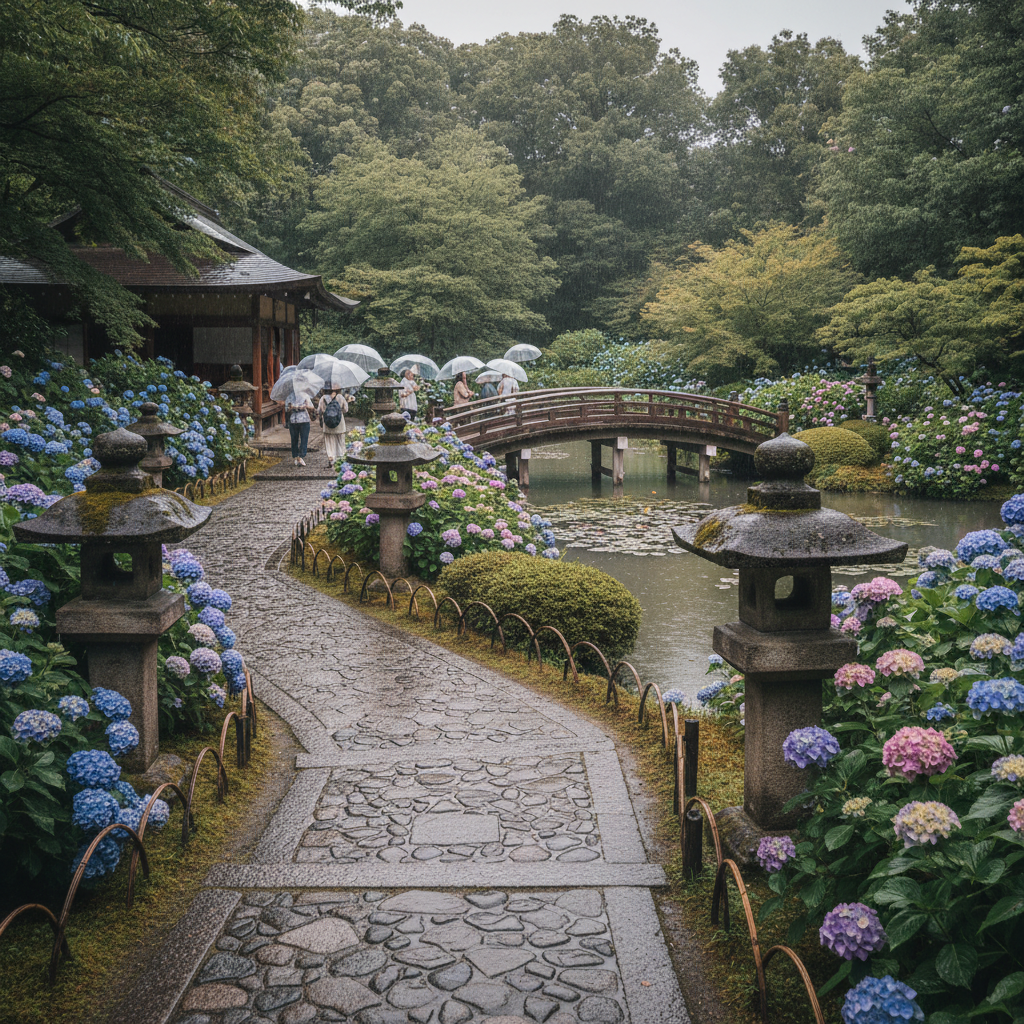
There is a particular kind of traveler who arrives in Japan during cherry blossom season expecting solitude and finds instead a sea of umbrellas, packed train platforms, and hotels priced as though the entire country knows it has exactly two weeks to impress. The experience is beautiful, genuinely so, but it is also shared with millions of others making the same pilgrimage at the same moment. What tends to get overlooked — by guidebooks, by social media feeds, and by the collective imagination of first-time visitors — is that Japan offers something quieter, greener, and considerably more affordable just a few months later, when the rains arrive and the crowds quietly dissolve.
The Character of Tsuyu
The Japanese rainy season, known as *tsuyu* (梅雨), which translates loosely as "plum rain," typically runs from early June through mid-July across most of Honshu, the main island. It is not a season of constant downpour. The rain tends to arrive in soft, persistent spells — mornings that smell of wet cedar, afternoons that clear unexpectedly into pale golden light, evenings when mist clings to temple rooftops in Kyoto's Higashiyama district. The atmosphere it creates is, in many ways, closer to the aesthetic Japan has cultivated for centuries through its art, poetry, and architecture than the frenzied brightness of peak sakura season. The concept of *wabi-sabi* — finding beauty in imperfection and transience — feels genuinely at home in a landscape damp with rain and draped in deep, saturated greens.
What the Crowds Actually Do to the Experience
During cherry blossom peak, which can fall anywhere from late March into mid-April depending on the year, certain destinations become genuinely difficult to experience in any meaningful way. Philosopher's Path in Kyoto, Maruyama Park, and the area around Senso-ji Temple in Tokyo's Asakusa neighborhood fill to a density that makes quiet reflection impossible. Reservations at traditional ryokan accommodations are often required months in advance, and prices at even modest guesthouses in Kyoto can more than double compared to off-peak rates. The economic logic is straightforward: demand surges, supply stays fixed, and travelers pay accordingly. During tsuyu, that equation reverses almost entirely. Accommodation rates drop noticeably, rail travel feels spacious, and popular temples become the kind of places one can wander without constant negotiation for physical space.
Affordability Beyond Accommodation
The savings during the rainy season extend well beyond hotel rates. Domestic flights within Japan, particularly on routes between Tokyo's Haneda Airport and cities like Osaka or Fukuoka, tend to reflect lower demand during this period. Day-trip destinations that are borderline inaccessible in spring — the bamboo groves of Arashiyama in Kyoto, the torii gates of Fushimi Inari, the deer park in Nara — become genuinely walkable without the crowd management that peak season demands. Restaurant reservations, even at establishments that require weeks of planning during cherry blossom season, often open up with shorter lead times. For travelers using the Japan Rail Pass, the difference is felt most clearly in how relaxed the actual journey becomes rather than in the pass price itself, since shinkansen seats that are heavily contested in April are far easier to claim in June.
What Rain Does to Japanese Landscapes
One of the most underappreciated aspects of tsuyu is what it does visually and atmospherically to the country's most celebrated natural settings. The moss gardens of Saihoji Temple in Kyoto — a place sometimes called Kokedera, or the Moss Temple — are at their most vivid and textured during and after rainfall, the greens deepening into something almost otherworldly. The cedar forests of Yakushima, a UNESCO-listed island off Kyushu's southern coast, are ecologically inseparable from the moisture the rainy season brings; visiting during tsuyu means seeing those ancient trees in the conditions that shaped them. Even ordinary urban spaces — neighborhood shrines, tiled rooftops, stone-paved lanes in older quarters — take on a particular quality in the rain that feels more consonant with Japan's artistic heritage than the same scenes would under harsh summer sun.
Packing and Practical Adjustments
Traveling during the rainy season requires modest preparation rather than dramatic sacrifice. A compact, wind-resistant umbrella is essential — Japan's konbini convenience stores, including 7-Eleven and Lawson locations found on nearly every city block, stock reliable options at low cost if a traveler arrives underprepared. Lightweight waterproof footwear matters more than in other seasons, particularly for anyone planning to visit garden or temple grounds where stone paths become slippery. Indoor attractions — the teamLab digital art spaces in Tokyo and Osaka, the many exceptional museum collections across both cities, the covered shopping arcades known as *shotengai* that run through neighborhoods like Kyoto's Nishiki market area — become natural anchors for itineraries, offering substance on heavier rain days without forcing any sense of compromise.
A Different Kind of Arrival
For those who find their way to Japan during tsuyu, the experience tends to settle into something more personal and less performative than peak-season travel allows. The temples feel like they belong to whoever is standing in them. The train platforms, even in cities, have a rhythm that doesn't require careful choreography to navigate. A traveler can sit in a covered garden in Kanazawa, watch rain move across the surface of a pond at Kenroku-en, and encounter something closer to the stillness that draws people to Japan in the first place. The cherry blossoms are real and worth seeing — but they are one version of Japan, the most crowded and expensive version, the one most mediated by expectations. The rainy season offers another version: the same country, the same beauty, and considerably more room to actually be present within it.
There is something fitting in the fact that the traveler who arrives expecting solitude during sakura season and finds instead a crowd might, a few months later, find exactly what they were looking for — in the rain, in the quiet, and at a fraction of the cost.