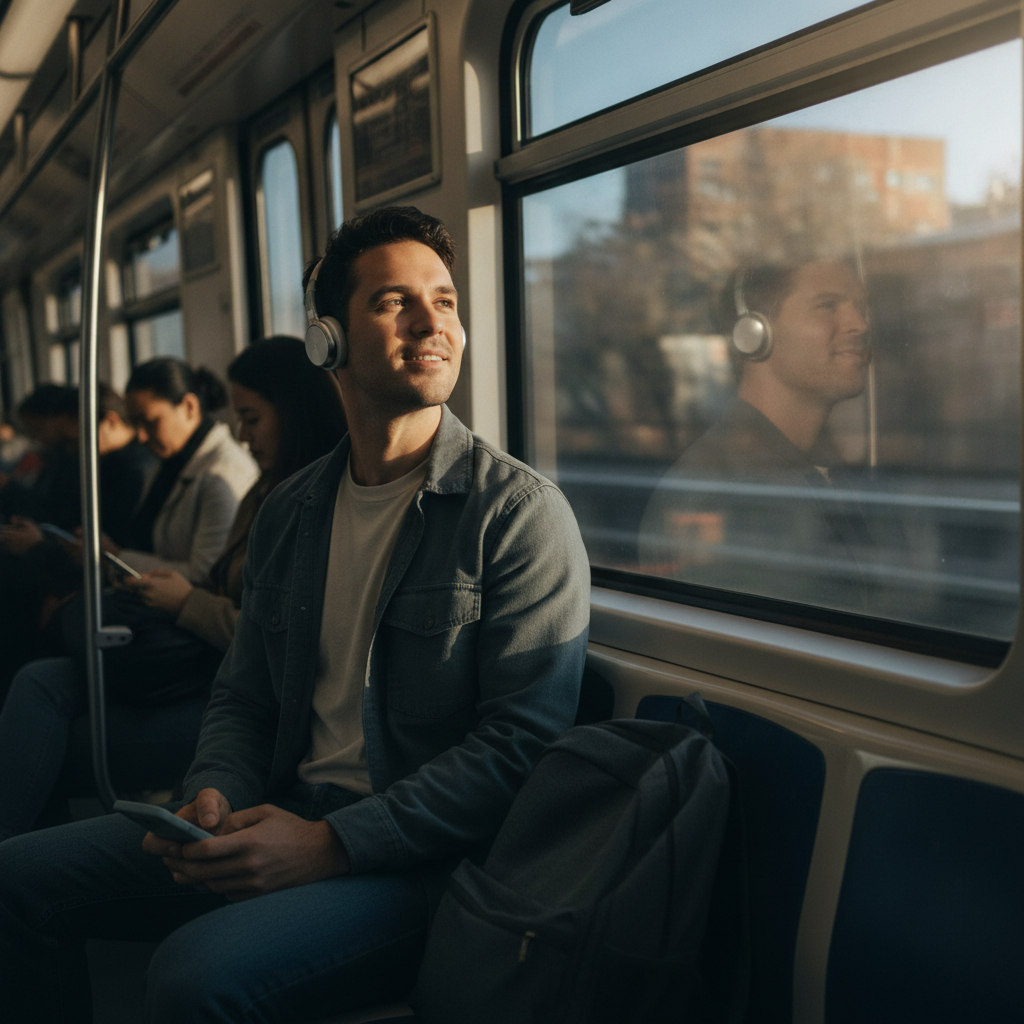
Sound has always been the commuter's private world — a boundary drawn between the noise of a crowded train and whatever the listener chooses to inhabit instead. For years, that boundary was defined by volume and noise cancellation alone. But a quieter shift has been underway in how audio actually reaches the listener, and spatial audio is at the center of it. What began as a feature associated with home theater systems and gaming headsets has gradually made its way into compact wireless earbuds, and the effect on everyday listening is more meaningful than most people expect.
What Is Spatial Audio, and How Does It Work?
Spatial audio is a processing technique that creates the perception of three-dimensional sound from a stereo source. Rather than delivering audio in the traditional left-right channel split, it uses head-related transfer functions — essentially mathematical models of how the human ear receives sound from different directions — to simulate depth, height, and movement. When implemented well, the result is that audio appears to exist around the listener rather than inside their head. Apple's AirPods Pro and Sony's WF-1000XM5 both offer versions of this technology, using onboard accelerometers and gyroscopes to track head movement and adjust the soundstage in real time.
Why Podcasts Feel Different With Spatial Processing Enabled
The podcast format is, at its core, a conversation — and spatial audio makes that conversation feel more like one you're physically present for. When a host's voice appears to emanate from a fixed point in front of the listener rather than from directly inside the ear canal, the brain processes it differently. Listening fatigue tends to reduce, and comprehension often improves as a result. For commuters absorbing dense material — interview-style shows, narrative journalism, or educational content — this distinction matters over the course of a long ride. The effect is subtle but cumulative, and regular listeners who switch between spatial and standard playback often notice the absence more than the presence.
How Spatial Sound Is Reshaping the Conference Call Experience
Remote and hybrid work have made voice calls a central feature of daily life, including during commutes when workers catch up on scheduled check-ins from trains, buses, or rideshares. Spatial audio has introduced a new dimension to multi-person calls by assigning each participant a distinct position in a simulated room. Apps like Microsoft Teams have integrated spatial audio rendering that places colleagues at different points around the listener, making it easier to follow who is speaking during group conversations. The practical benefit is real — parsing overlapping voices or tracking a fast-moving discussion becomes noticeably less mentally taxing when each voice has its own perceived location.
What Spatial Audio Does — and Doesn't Do — for Music
For music, spatial audio delivers its most dramatic results with content specifically mixed for the format. Dolby Atmos Music tracks, available through Apple Music and Tidal, are engineered to take advantage of three-dimensional playback, placing instruments and vocals at deliberate positions in a wide soundstage. Classical recordings, ambient electronic music, and live performances tend to benefit most, with orchestral arrangements in particular sounding genuinely expansive on compatible earbuds. Standard stereo mixes converted in real time through spatial processing show more mixed results — some listeners find them more immersive, while others find the widened field disorienting or unnatural. The quality of the original recording and the processing algorithm both play a significant role.
How Head Tracking Changes the Listening Experience in Motion
One of the more technically interesting aspects of modern spatial audio implementations is dynamic head tracking — the ability of earbuds to detect when the listener turns their head and adjust the audio field accordingly, keeping the soundstage anchored to a fixed point in space. In a stationary environment, this creates a convincing illusion of presence. During commutes, the picture is more complex. Listeners who remain relatively still — reading, working, or looking ahead — often find head tracking enhances immersion. Those who move more actively, turning frequently in a busy environment, may find the effect disorienting and prefer to disable it. Both Apple and Sony have made this feature toggleable, allowing listeners to calibrate the experience to their own movement patterns.
How to Get the Most From Spatial Audio on Your Commute
If you're already using earbuds that support spatial audio — whether that's AirPods Pro, Sony's flagship earbuds, or Samsung's Galaxy Buds Pro line — it's worth spending a few minutes adjusting the settings rather than leaving them at their defaults. Start by enabling spatial audio specifically for podcast and call use, where the voice-centering effect tends to be most immediately noticeable. For music, test the difference between Dolby Atmos tracks and standard streams before forming a judgment — the format is only as good as the source material. If head tracking feels disorienting during movement-heavy rides, turn it off and leave the soundstage fixed. Most platforms let you control these features independently, so you're not locked into a single setting across all content types.
Spatial audio in wireless earbuds is still evolving, and the next generation of improvements is likely to focus on personalization — using machine learning to map each individual's ear shape and build a custom head-related transfer function rather than relying on generalized models. Several audio hardware brands are already developing ear-scanning tools through companion apps. As that personalization layer matures, the gap between what spatial audio promises and what most listeners actually experience on a daily commute is likely to close considerably, making the technology less of a niche feature and more of a genuine standard for how people consume audio on the move.