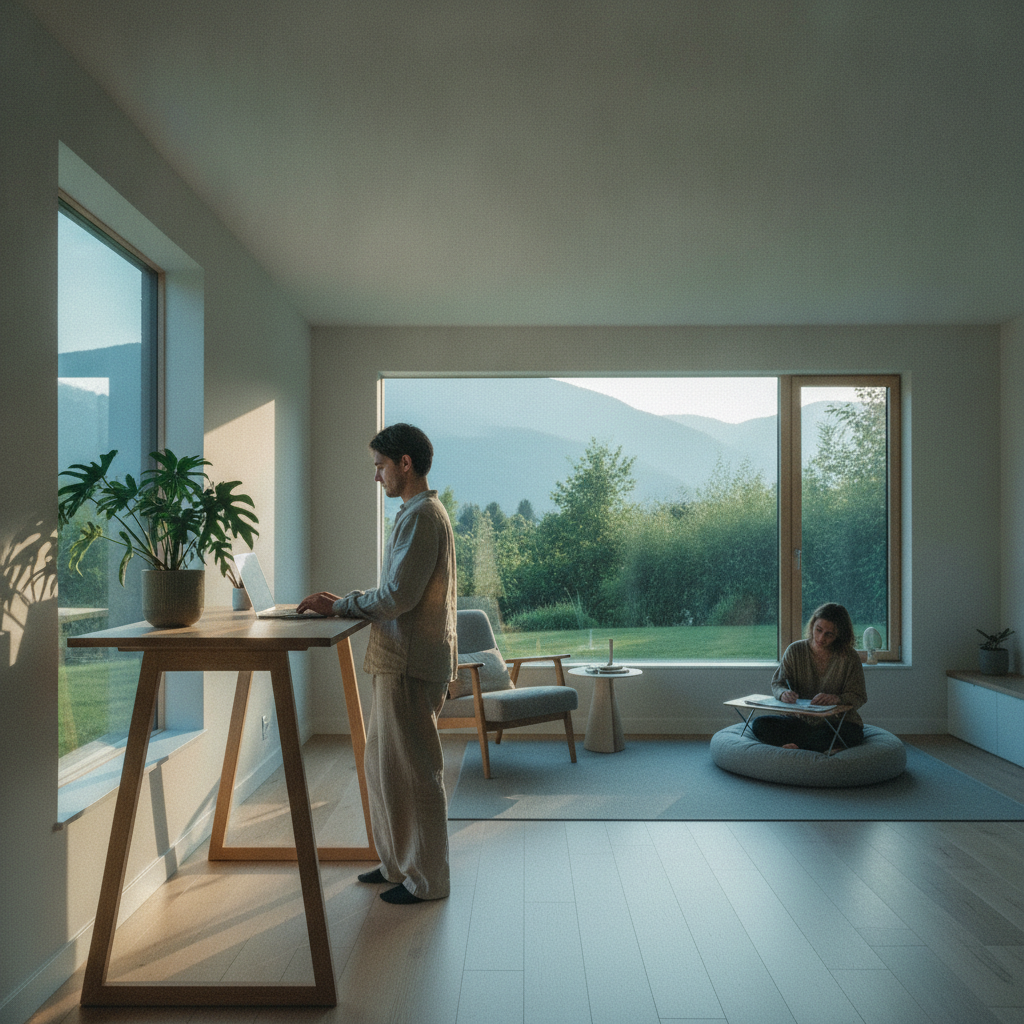
The position of a desk in a home is rarely treated as a biological decision, yet the quality of natural light reaching a worker at nine in the morning versus two in the afternoon can shape cognitive output more profoundly than any productivity app or morning ritual. Most people set up a workspace once — anchoring furniture to walls, power outlets, or aesthetic preference — and then adapt to whatever light conditions result, often without realizing that a fixed position might be quietly working against the body's internal rhythms. The relationship between ambient daylight and sustained mental clarity is well-established in exercise science and chronobiology alike, and designing a home workspace to move with natural light cycles, rather than against them, is one of the more overlooked variables in modern remote work environments.
How the Body Responds to Shifting Daylight
The human circadian system is exquisitely sensitive to the color temperature and intensity of natural light across the course of a day. Morning light, which skews toward cooler, bluer wavelengths, signals the brain to suppress residual melatonin and elevate cortisol, establishing the alertness baseline that carries a person through their first productive hours. As the day progresses, light shifts warmer and dims in intensity, which cues a gradual hormonal wind-down. When a fixed workspace keeps someone in deep shadow during peak morning hours or floods their field of vision with harsh afternoon glare, these natural cues are distorted, contributing to the kind of mid-afternoon fatigue that most people incorrectly attribute to diet or sleep debt.
The Problem With Fixed Desk Placement
Conventional interior design prioritizes permanence, and most home office setups reflect that. A desk against a north-facing wall might offer consistent, diffuse light with minimal glare — appealing in theory — but it also deprives the brain of the high-intensity daylight exposure that supports dopamine regulation and sharp early-morning focus. South-facing desks, by contrast, can deliver punishing glare by mid-morning, particularly in open-plan apartments in cities like Austin or Sydney where buildings are designed with large window footprints. The instinct is to close the blinds, which resolves the glare problem but eliminates the circadian benefit entirely — a compromise that serves neither comfort nor cognitive performance.
Designing for Light as a Moving Variable
A growing number of interior wellness consultants and workplace ergonomics specialists now advocate for what is sometimes called dynamic positioning — the practice of designing a home workspace with intentional flexibility, so that the worker's primary surface, seating, and screen orientation can shift across the day without significant disruption. Brands like Fully and Branch have developed modular desk systems that support this kind of reconfiguration, with lightweight tops and adjustable frames that don't require professional installation to reposition. The concept doesn't demand a large space; even a small apartment can accommodate two distinct work zones — one oriented for morning light and one sheltered from afternoon intensity — without requiring a dedicated room.
The Role of Light Direction in Cognitive Task Matching
Beyond general alertness, the angle and quality of light reaching the workspace influences which types of cognitive tasks feel most accessible at a given hour. Direct, high-lux morning light is strongly associated with convergent thinking — the ability to focus narrowly, solve structured problems, and retain new information — which makes it biologically optimal for analytical work, writing, or detailed review. Softer, indirect afternoon light tends to support more expansive, associative thinking, the kind that benefits brainstorming, creative synthesis, or open-ended planning. Designing a workspace that positions a person within direct morning light for heads-down work, then shifts them to a softer ambient environment for the afternoon, aligns the physical environment with the brain's natural cognitive rhythm rather than fighting it.
Practical Tools That Support Light-Aware Workspaces
If you're considering redesigning your workspace around light cycles, the first practical step is observing where natural light actually falls in your space at different points in the day — not where you assume it falls. A simple light meter app like Lux Light Meter Pro can quantify this without guesswork. From there, consider wheeled or caster-equipped desks that allow genuine repositioning rather than symbolic flexibility. Adjustable monitor arms from brands like Ergotron extend screen positioning options significantly, allowing the display to follow the worker rather than anchoring them to a single wall. Light-filtering window films — available in varying opacity levels from companies like 3M — let morning light pass while tempering the harsh spectrum shifts of midday without the need for blinds.
When Artificial Light Fills the Gap
Natural light is not always available in sufficient quality or quantity, particularly in northern climates during winter months or in basement and interior-facing apartments. In these circumstances, the circadian logic still holds — the goal is replicating the color temperature progression of natural daylight rather than defaulting to a single static overhead source. Smart bulbs on platforms like Philips Hue or LIFX can be programmed to shift from cooler, high-lux settings in the morning to warmer, lower-intensity light by mid-afternoon, preserving the hormonal signaling sequence even when actual sunlight is absent. This approach won't replicate the full spectrum of outdoor light, but it meaningfully supports the alertness and wind-down cues the body relies on to sustain energy and focus across a full working day.
The opening observation holds: where a person sits to work is rarely treated as a biological decision, but the evidence suggests it probably should be. A workspace that adapts to the arc of natural light — rather than one that fixes a person in a single relationship to it — gives the body the environmental cues it needs to regulate alertness, manage energy, and sustain meaningful output across the day. The desk, the monitor arm, the position of the window: none of these are merely aesthetic choices. They are, in a quiet but measurable way, tools for thinking clearly.