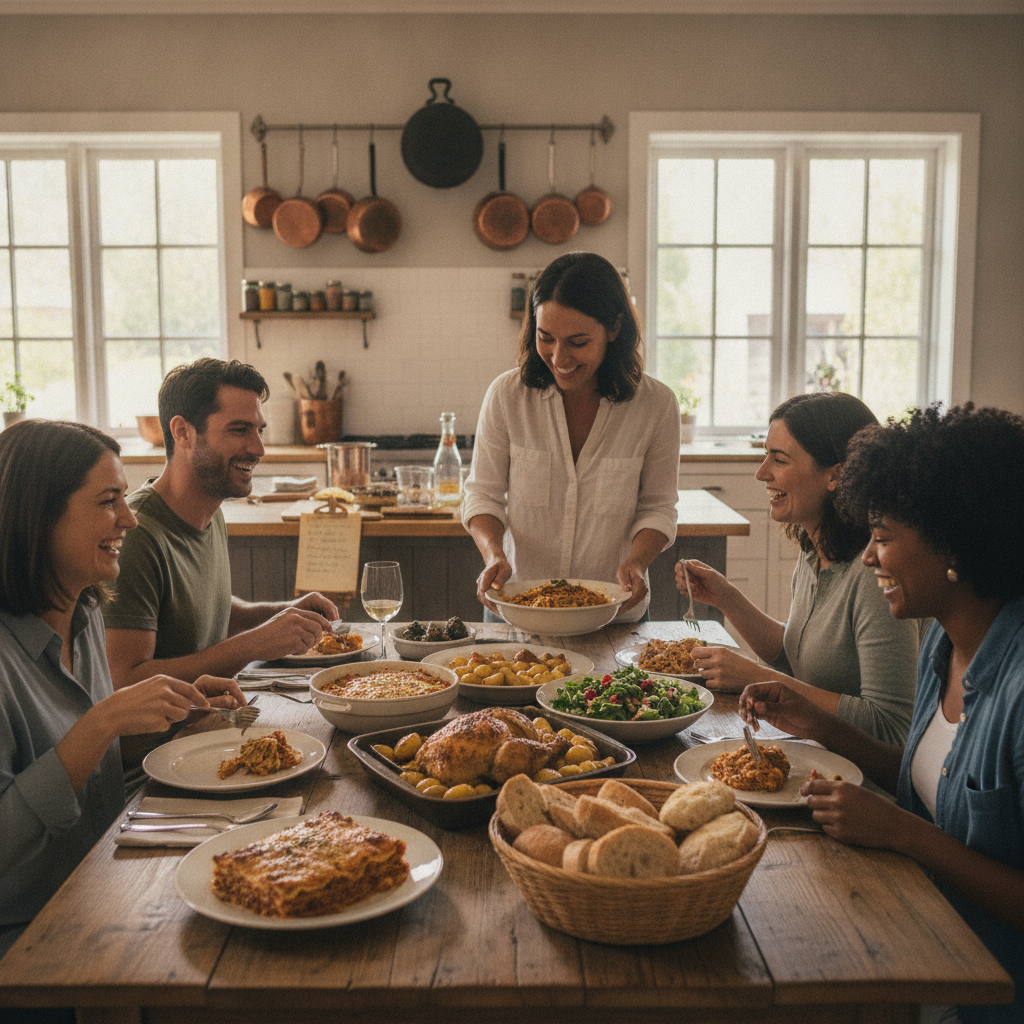
There is a particular kind of anxiety that settles into a kitchen the evening before guests arrive — a low hum of uncertainty that has less to do with the food itself and more to do with the unfamiliar. The host who attempts a new dish for company is not just cooking; they are managing variables they have never met before, trusting an untested process while simultaneously tending to everything else that makes a gathering feel easy and warm. This is a common trap that many well-intentioned home cooks fall into: the belief that variety signals effort, and that effort is what guests most appreciate. In reality, what makes a home feel welcoming has far more to do with the ease of the person holding the ladle than the complexity of what is in the pot.
The Psychology Behind Familiar Repetition
Culinary confidence is not a fixed trait — it is a skill built through repetition, through understanding how a dish behaves across different conditions, different ovens, different crowds. When a cook returns to the same handful of recipes across multiple gatherings, something important happens beneath the surface. The dish stops being a task and becomes a kind of muscle memory, a practiced conversation between cook and kitchen. In French culinary tradition, this is sometimes described as *avoir la main* — literally, "having the hand" — the intuitive ease that comes only after making something enough times to feel it rather than think it. A host who has made the same slow-braised lamb or the same roasted tomato pasta a dozen times no longer needs to consult a recipe card at a critical moment. That freedom is what allows them to actually be present with their guests.
The restaurant world understood this long before home cooks did. Neighborhood spots in cities like Bologna, Lyon, and Oaxaca have built loyal followings not by rotating through an ever-expanding menu, but by doing a narrow set of things extraordinarily well. The regulars return not despite the predictability, but because of it. Home entertaining operates by a similar logic, even if the scale and stakes are smaller. When a cook stops treating each dinner party as a test of their range and starts treating it as an opportunity to deepen mastery, the dynamic shifts entirely — from performance to presence.
What a Small Recipe Rotation Actually Looks Like
A well-curated hosting rotation does not need to be elaborate. In practice, it often means selecting somewhere between four and eight dishes that span a few key roles — a reliable starter, a main that scales easily, a side that travels well between seasons, and a dessert simple enough to prepare ahead. These become the host's *répertoire* (a French term meaning the set of pieces a performer knows thoroughly and can deliver without preparation), called upon with increasing confidence each time guests are invited. Platforms like NYT Cooking or apps like Whisk are useful for organizing this kind of intentional shortlist, but the real work is in the choosing: picking dishes that genuinely excite the cook, that suit their kitchen's strengths, and that can absorb small variations without collapse.
What matters most is not the specific dishes selected but the principle behind the selection. A host in a small apartment in Chicago's Logan Square with one reliable burner and a dependable Dutch oven will build a completely different rotation than someone with a full kitchen in a house in the suburbs — and both rotations can be equally successful if they are honest about what the space and cook can comfortably deliver. The goal is not to impress with ambition; it is to create conditions in which the food arrives at the table with calm and without drama.
The Guest Experience That Repetition Quietly Creates
Guests rarely arrive at a dinner table thinking about novelty. They arrive hoping to feel welcome, fed, and at ease in someone else's home — to experience what the Japanese call *omotenashi*, a form of wholehearted hospitality rooted not in spectacle but in attentive, unhurried care. When a host is relaxed and grounded, that ease is contagious. Conversation flows differently. The evening has a different texture. And that quality — that unmistakable sense that no one is straining — is almost impossible to manufacture from behind the stress of an untested recipe.
There is also something quietly generous about a dish that a host has made many times. It carries a kind of intention in it, a signal that this food was chosen specifically for this occasion rather than assembled as a novelty. Guests often sense this without being able to name it. A slow-roasted chicken that has been perfected over eighteen months of Sunday dinners communicates something that a technically adventurous but anxious first attempt simply cannot. The confidence of the cook flavors the food as surely as the seasoning does.
Building Your Own Rotation With Intention
If you are drawn to this approach, the most useful first step is not to cook more but to notice more — to pay attention to which dishes you return to naturally, which ones your guests ask about again, and which ones left you feeling most like yourself in the kitchen. Those patterns are already telling you something. From there, the work is one of gentle curation rather than aggressive learning: refining a vinaigrette until it needs no measuring, learning how a particular grain absorbs broth in your specific pot, understanding exactly when your oven runs hot and adjusting for it without thinking. These small calibrations accumulate into something real. Over time, the rotation becomes a kind of signature — a set of flavors and textures that friends associate with your table, that carry continuity across seasons and years. That continuity, more than any single impressive dish, is what builds a reputation as someone worth eating with.
The kitchen the night before a gathering does not have to feel like a test. It can feel, instead, like returning to something already known — and that shift, from uncertainty to ease, is the quiet foundation on which genuine hospitality is built.