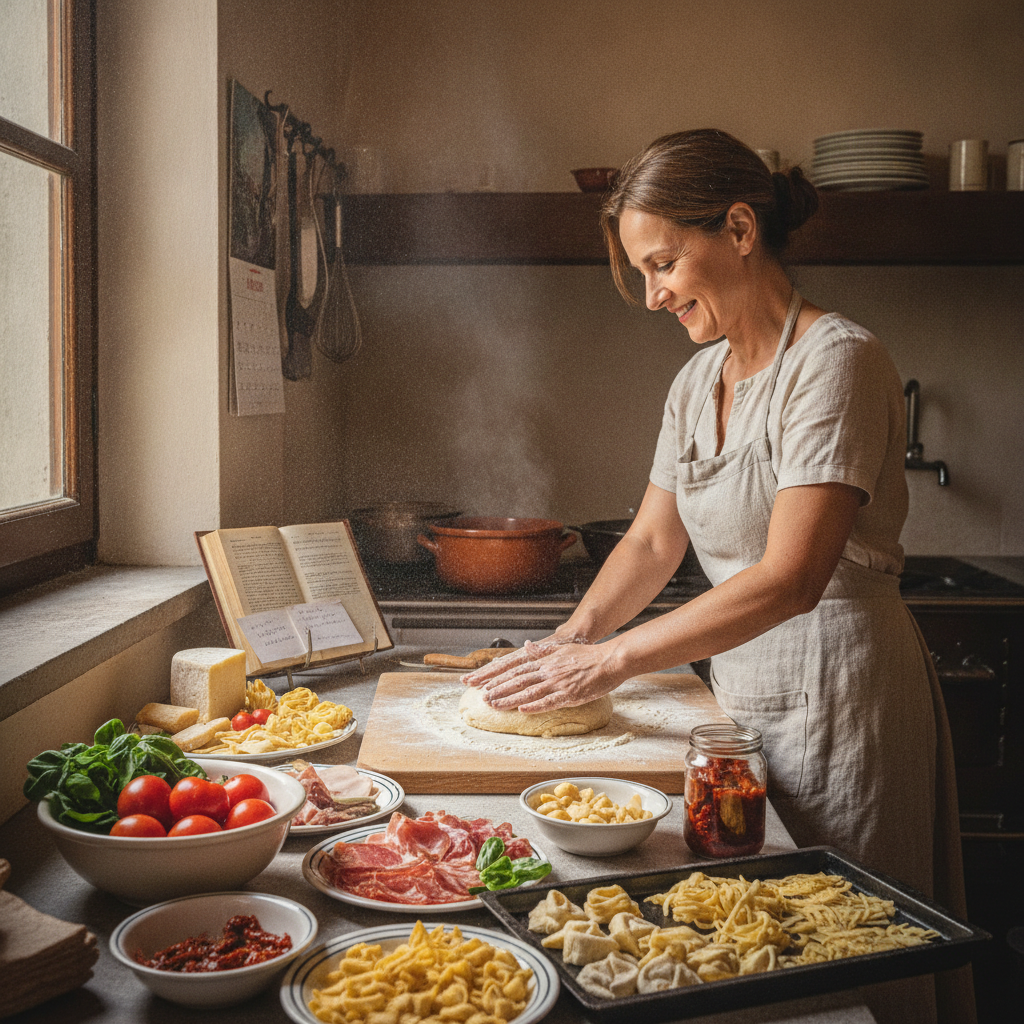
Most home cooks accumulate recipes the way travelers collect passport stamps — broadly, enthusiastically, and without much depth. A Thai stir-fry one Tuesday, a Moroccan tagine the following weekend, an Italian pasta dish squeezed in somewhere before the month ends. The variety feels productive, even educational. But the kitchen rarely improves in any meaningful way, because the foundational logic beneath each cuisine — the flavor relationships, the techniques, the ingredient hierarchies — never gets enough time to take root.
The Shallow Learning Trap of Recipe Rotation
Rotating randomly through cuisines creates the illusion of growth without delivering much of it. Each new recipe demands a completely different mental model: different aromatics, different acid-to-fat ratios, different approaches to heat and timing. A cook who makes pad thai one week and moussaka the next hasn't built a transferable skill — they've completed two isolated tasks. The learning resets with every new dish, and the hard-won instincts that come from repetition never accumulate into something usable.
How Regional Cuisines Are Built Around Internal Logic
Every great regional cuisine operates according to an internal grammar — a set of principles that governs how ingredients relate to one another. In Japanese washoku (the traditional dietary culture recognized by UNESCO), umami is coaxed through careful layering of dashi, miso, and fermented elements rather than through bold seasoning. In Sichuan cooking, the interplay of málà (the numbing heat of Sichuan peppercorn combined with chili) defines not just flavor but texture and sensation. Understanding these principles changes how a cook sees every recipe within that tradition. The dishes stop being individual tasks and start revealing themselves as variations on a theme.
Repetition as the Actual Teacher
When a cook spends a full month inside one cuisine — Oaxacan Mexican, say, or southern Indian — something shifts around the second or third week. The ingredients become familiar enough that shopping gets faster, improvisation becomes possible, and mistakes stop feeling like failures and start functioning as data. Making mole negro more than once reveals how the dried chiles evolve differently depending on how long they toast. Repeated batches of sambar teach how tamarind's sourness changes with cooking time. This kind of knowledge doesn't come from reading a recipe carefully. It comes only from doing the same thing, slightly differently, more than once.
What Transfers When the Month Ends
The skills built inside one cuisine are rarely as confined to that cuisine as they first appear. A month spent cooking French provincial food — the kind associated with regions like Provence or the Dordogne — builds a deep understanding of fond, the browned bits that form the base of countless sauces, and of how gentle, long heat transforms even tough cuts into something yielding and complex. These aren't French skills. They're cooking skills that happen to have been learned through a French context. The braising instinct, the sauce-building instinct, the patience — all of it transfers directly into any other cuisine that uses similar techniques.
The Pantry Becomes a Real Toolkit
One of the more practical side effects of regional immersion is what happens to the pantry. Random recipe rotation demands a constantly expanding, poorly organized collection of specialty ingredients purchased for a single dish and then forgotten. A month inside one cuisine forces the opposite: a focused, purposeful collection of ingredients that all relate to one another and get used repeatedly. The fish sauce bought for a Vietnamese canh chua (a tamarind-based sour soup) becomes essential to every dish that month. The pantry starts to feel like a toolkit rather than an archive of half-used bottles. Grocery spending often drops, waste decreases, and the cook develops genuine fluency with a smaller set of ingredients.
Choosing the Right Cuisine for a Month-Long Focus
Not every cuisine is equally well-suited for a month-long deep study, at least not for the same reasons. Cuisines with a strong internal structure and a wide recipe range — Japanese, Mexican, Indian, Italian, Moroccan — tend to reward sustained attention most generously. A resource like the cookbook series from Milk Street, or platforms like ChefSteps that emphasize technique alongside recipe, can provide the kind of structured entry point that keeps the month from feeling repetitive. Regional specificity matters, too. Narrowing from "Italian" to "Sicilian" or from "Indian" to "Keralan" sharpens the learning considerably, because the cuisine's internal logic becomes more coherent and the ingredient palette more consistent.
When Depth Becomes Its Own Kind of Freedom
There's a certain irony that emerges after a month spent cooking narrowly: the cook feels more free in the kitchen, not less. You start to understand why a dish is built the way it is, which means you can begin making it your own without breaking it. The recipe becomes a starting point rather than a constraint. The confidence that comes from genuine familiarity is different in texture from the tentative confidence that comes from following instructions carefully — it's quieter, less anxious, more grounded. And it doesn't disappear when you move on to the next cuisine. It compounds.
The home cook who rotates endlessly through random recipes is always a beginner, just in different kitchens. The one who spends a month somewhere — really somewhere, not just passing through — comes out the other side with something that belongs to them. The broad, enthusiastic approach to recipe collection is easy to understand. But the kitchen, like most things worth getting better at, tends to reward those who slow down long enough to understand what they're actually doing.